Published: November 2026
With so many Budget headlines to take in, it can be hard to know what actually matters for you and your money. Some changes happen straight away, others are months away, and some were announced in previous years. You do not need to work through it all on your own. Here, we look at the changes that could affect your savings, retirement and plans for your family, highlighting what has been confirmed and where we are still waiting for the full details.
Savings and rental income: you need to look beyond the headlines
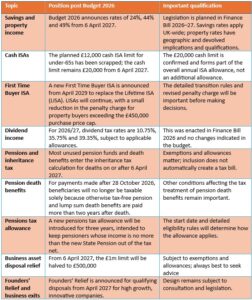
The Autumn Budget 2026 announces a further two-percentage-point increase in savings income tax rates, on top of the increases announced in last year’s Budget. The Budget in 2025 had already announced that the basic, higher and additional rates would rise from 20%, 40% and 45% to 22%, 42% and 47% from 6 April 2027. This year’s Budget increases those planned rates again, to 24%, 44% and 49% from 6 April 2027 across the UK. The new rates are therefore four percentage points above the original rates, rather than two. Separate property income tax rates of 24%, 44% and 49% are also announced for England, Wales and Northern Ireland from the same date, replacing the previously announced rates of 22%, 42% and 47%. The government plans to legislate for these additional increases in the Finance Bill 2026–27.
For savings, these rates apply to taxable interest, not the money you have saved in your account. HMRC’s published measure leaves the personal savings allowance and starting rate for savings unchanged, so the tax you pay will depend on your overall income and the allowances available to you. If you use interest or rental income to help cover everyday spending, your Financial Planner can help you understand what you will have available after tax and relevant costs.
From 6 April 2027, the published income tax rules also change the order in which allowances and reliefs are used. Where possible, they must first be applied to income other than property, savings and dividends, and only then to those income sources. If you receive a mixture of earnings, pension income, rent, interest and dividends, it is the overall tax calculation that matters – not just the headline rates.
Cash ISAs: planned allowance cut is scrapped
The Chancellor has scrapped the planned reduction in the annual cash ISA subscription limit for under-65s from £20,000 to £12,000, which had been due to take effect on 6 April 2027. Savers can continue to subscribe up to £20,000 a year to cash ISAs as part of the overall £20,000 annual ISA allowance.
April 2029: a new First Time Buyer ISA
A new First Time Buyer ISA is announced from April 2029 to replace the Lifetime ISA (LISA). LISAs will continue, with a small reduction in the penalty charge for property buyers who exceed the £450,000 purchase price cap. The detailed rules, including how the replacement will work alongside continuing LISAs and the revised charge, will be important before making decisions.
Entrepreneurs: new Founders’ Relief and business-exit planning
The notable change in the Budget was for entrepreneurs with John Healey announcing a new business-related relief, called Founders’ Relief; a new capital gains tax relief intended for founders and significant early investors in high-growth, innovative UK companies. The announced rate is 10% on qualifying share-disposal gains, up to a £10 million lifetime limit per individual, for qualifying disposals on or after 6 April 2027. This is a limit on qualifying gains, not sale proceeds, however early indications are that this is not an automatic benefit for every entrepreneur or business sale.
The design is still subject to consultation and legislation. The Treasury’s technical consultation closes on 30 November 2026 and covers individual, company, growth and innovation conditions, with legislation planned for Finance Bill 2026/27. We would err on the side of caution until the full details have been published by the Treasury.
Founders’ Relief is distinct from Business Asset Disposal Relief (BADR), formerly Entrepreneurs’ Relief. The BADR rate is 18% from 6 April 2026. In the Budget, the Chancellor announced there would be a reduction in its lifetime qualifying-gains limit from £1 million to £500,000 for disposals from 6 April 2027. This will have a significant impact on business owners thinking of exiting their business in the future. If you would like further advice on BADR, please get in contact with one of our Financial Planning team.
Dividend income: a change already in effect
The dividend tax increases announced at last year’s Budget were enacted in Finance Act 2026 and took effect from 6 April 2026. The Chancellor made no changes to this in the recent budget and so for 2026/27, the basic and higher dividend rates are 10.75% and 35.75%, while the additional rate remains 39.35%. The tax you pay depends on your total income and applicable allowances, including the £500 dividend allowance.
Pensions and inheritance tax: consider retirement and family plans together
As with dividend tax, the Chancellor retained the plans announced by his predecessor, Rachel Reeves for deaths on or after 6 April 2027, most unused pension funds and pension death benefits will be included in the value of the deceased’s estate for inheritance tax purposes. Exclusions include death-in-service benefits payable from registered pension schemes and dependant’s scheme pensions from defined benefit or collective money purchase arrangements. Available exemptions and allowances, including the spouse or civil partner exemption where applicable, mean that inclusion does not automatically create an inheritance tax bill.
A conversation with your Financial Planner can help you consider the full picture and what makes sense for your individual circumstances in relation to this.
Pension death benefits: a change to the two-year rule
The Budget also announces technical amendments to pension death benefits. For payments made after 28 October 2026, beneficiaries will no longer be taxable solely because otherwise tax-free pension and lump sum death benefits are paid more than two years after death. This does not mean that all pension death benefits are tax-free: the other conditions affecting their tax treatment remain important.
A temporary pensions tax allowance
A new pensions tax allowance will be introduced for three years, intended to keep pensioners whose income is no more than the new State Pension out of the tax net. The start date and detailed eligibility rules will be important in understanding how the allowance applies to individual circumstances.
Other dates to keep on your financial-planning radar
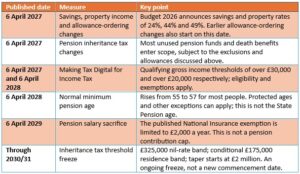
There are also a few dates worth keeping in mind over the coming years. Making Tax Digital, the pension access age increase and the pension salary-sacrifice reform were announced before the Autumn Budget 2026. The April 2027 savings and property rates above include additional increases announced in this Budget, whereas the pension inheritance tax changes were legislated for earlier. Keeping that distinction clear can help you decide when to revisit your plans.
April 2027 and April 2028: Making Tax Digital reaches more people
Making Tax Digital for Income Tax extends to eligible sole traders and landlords with qualifying gross income over £30,000 from 6 April 2027, and over £20,000 from 6 April 2028, subject to exemptions. The over-£50,000 phase began on 6 April 2026. The test concerns combined qualifying income from self-employment and property before expenses, not profit or all household income, and generally uses income reported for an earlier tax year to determine the start date. Those affected need digital records and compatible software to send quarterly updates and complete their tax return. Quarterly updates are not four additional tax returns. If you may fall within scope, an early conversation with your accountant or tax adviser can help establish your start date and reporting arrangements.
April 2028: the normal minimum pension age rises to 57
From 6 April 2028, the earliest age at which most people can access workplace or personal pension benefits without an unauthorised-payment tax charge rises from 55 to 57. This is separate from the State Pension age. Protected pension ages, ill-health provisions and exceptions for the armed forces, police and firefighters’ public service schemes can affect the position. If your retirement plans depend on accessing a pension before 57, check the rules applying to your individual schemes rather than assuming all pensions have the same access date.
April 2029: National Insurance treatment of pension salary sacrifice changes
HMRC’s published measure takes effect from 6 April 2029. Only the first £2,000 a year of salary or bonus sacrificed for pension contributions will remain exempt from National Insurance contributions. Amounts sacrificed above that limit will attract employee and employer National Insurance. This is not a £2,000 cap on pension saving: income tax relief continues subject to the usual rules, and ordinary employer pension contributions outside salary sacrifice retain their existing National Insurance treatment. Employees and employers using salary sacrifice should understand the implications for take-home pay and contribution costs as the detailed implementation guidance develops.
Through 2030/31: inheritance tax thresholds remain frozen
Under HMRC’s published timetable, the standard inheritance tax nil-rate band remains £325,000, the residence nil-rate band remains £175,000, and the residence allowance taper continues to start at an estate value of £2 million, through the 2030/31 tax year. The residence allowance is conditional, including requirements relating to a qualifying home passing to direct descendants, and is reduced for larger estates. This is an ongoing freeze rather than a new rule beginning after today’s Budget. If asset values rise while thresholds remain unchanged, more of an estate can become exposed to inheritance tax – another reason to consider estate planning alongside retirement needs.
Your plans come first – we are here to help
You do not need to have all the answers before speaking to your Financial Planner. A useful starting point is simply to ask: does this affect me, when does it happen, and does it change what I need from my money? Together, you can look at your savings, investments, pensions and family commitments as a whole. Your goals remain the starting point, whatever the headlines say.
If you have any questions, please contact us on 01223 233331 or email info@mmwealth.co.uk before making decisions – there is more value in understanding what is right for you than in rushing to act.
Disclaimer
Opinions constitute our judgment as of this date and are subject to change without warning. The value of investments and the income from them can go down as well as up, and you may not recover the amount of your original investment. Past performance is not a reliable indicator of future performance.
This article is for general information only and does not constitute personal financial advice, a personal recommendation, or an offer or solicitation to buy or sell any investment.
The information contained within this blog is based on our understanding of legislation, whether proposed or in force, and market practice at the time of writing. Levels, bases and reliefs from taxation may be subject to change, and tax treatment depends on individual circumstances.
The Financial Conduct Authority does not regulate estate planning and tax planning.