Author: Geoff Cooper
Head of Investment Management, Chartered Wealth Manager - Chair of the Investment Committee
View profile
Published: April 2026
Gold has long carried a reputation as the ultimate safe haven. When markets wobble, inflation rises or geopolitical tensions flare, investors often expect the yellow metal to shine. The recent conflict in the Middle East, and the subsequent pullback in gold prices, may therefore have come as a surprise to many. But rather than undermining the case for gold, recent events have provided a useful reminder that reputation alone is not enough to understand how any asset behaves in the short term.
Coming into the Iran conflict, gold had already enjoyed a very strong run. Concerns over persistent inflation, elevated government debt, ongoing geopolitical tensions and robust central bank buying had all helped to push prices sharply higher. As a result, by the time the latest tensions escalated, a significant amount of fear and uncertainty had already been reflected in the price. In simple terms, gold had already been doing much of the job investors expected it to do.
That matters because markets rarely move in a straight line. When an event that should support gold is already anticipated, the reality can often be more muted. In this case, some investors who had enjoyed strong gains simply took profits, while others were forced to raise cash as volatility spread across wider markets. Gold is one of the most liquid assets in the world, which means it can often be sold quickly and easily in times of stress.
That helps explain one of the great ironies of market behaviour: when investors fear the future, they buy gold; when they fear the present, they sell what is liquid. It may feel counterintuitive, but history shows this is not unusual. In periods of sudden market stress, gold can fall alongside equities, not because its longer-term value has disappeared, but because short-term market mechanics temporarily take over.
For context, the chart below shows how gold has behaved during several recent market shocks, including the pandemic, helping to illustrate why short-term pullbacks are often part of the journey rather than a sign that the longer-term case has changed.
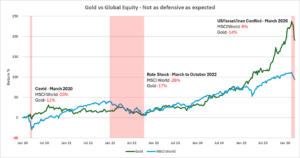
Source: Morningstar, MM Wealth Investment Team. LBMA Gold Price and MSCI World Index, in USD. Data for period 01/01/2020 to 31/03/2026.
There were other factors at play in March too. The recent conflict pushed oil prices higher and reignited concerns about inflation, particularly given the importance of the Strait of Hormuz to global energy markets. Rather than creating a straightforward “risk-off” backdrop, this created fears of stagflation – slower growth alongside higher prices. In this environment, government bond yields rose and the US dollar firmed, both of which can act as a headwind for gold. Unlike bonds or cash, gold doesn’t generate an income, so when yields rise, the relative appeal of holding it can diminish in the short term.
This short-term weakness shouldn’t distract from the bigger picture. Gold’s real role in portfolios has never been about providing instant protection in every market wobble or geopolitical flare-up. Its true value lies in offering longer-term diversification against deeper risks: inflation, excessive government borrowing, currency debasement and geopolitical fragmentation.
If anything, the structural case for gold remains strong. Central banks around the world have continued to add to their gold reserves in recent years, reflecting a desire to diversify away from an overreliance on US government debt and the dollar. At the same time, fiscal pressures remain elevated across many developed economies, while geopolitical fault lines are becoming more entrenched. These are precisely the sort of long-term forces that tend to support gold over time.
So, has gold lived up to its reputation? In the short term, perhaps not as many investors expected. But that doesn’t mean it’s failed. Rather, recent price moves are a timely reminder that safe havens don’t always behave in the way headlines suggest. Gold can disappoint in the moment, particularly when it’s already rallied strongly or when investors are scrambling for liquidity. Yet over the longer term, its role as a store of value and diversifier remains intact.
We are always here to help you with any questions or concerns you may have. If you would like to talk to one of our Chartered Financial Planners, please contact us on 01223 233331 or email info@mmwealth.co.uk.
Disclaimer
Opinions constitute our judgement as of this date and are subject to change without warning. The value of investments and the income from them can go down as well as up, and you may not recover the amount of your original investment. Past performance is not a reliable indicator of future performance.
The information in this article is not intended as an offer or solicitation to buy or sell securities or any other investment, nor does it constitute a personal recommendation.
The information contained within this blog is based on our understanding of legislation, whether proposed or in force, and market practice at the time of writing. Levels, bases and reliefs from taxation may be subject to change.