Author: Geoff Cooper
Head of Investment Management, Chartered Wealth Manager - Chair of the Investment Committee
View profile
Published: June 2026
Why Wealth Is Usually Built When the News Looks Worst
“Time in the market, not timing the market” is a phrase I use regularly in client communications or when talking to our team of chartered financial planners. The principle is simple: successful investing is usually less about making perfect predictions and more about staying invested long enough for compounding to do its work. The question, of course, is whether the old adage still holds true when the outlook feels particularly uncertain.
And it feels particularly relevant today. Turn on the news and you’re met with a steady stream of concerns: geopolitical tensions, rising government debt, trade disputes, stubborn inflation and growing fears of economic slowdown. At times, it feels like a market correction or recession is lurking just around the corner.
Those concerns are real. In fact, many of them are risks we discuss regularly within our own investment process. Yet it also prompted me to revisit what some of the most respected investors and researchers have written about periods of uncertainty and market stress.
A paper from Cambridge Associates, ‘Managing Portfolios Through Equity Market Downturns’ [1], highlights that successful investors typically enter difficult periods with a plan already in place rather than reacting emotionally when markets become volatile. Discipline, it argues, is often more valuable than prediction.
Looking through J.P. Morgan’s latest ‘Guide to the Markets’ [2] – which I highly recommend for those of a mind to explore further – I was struck by a chart showing the subsequent performance of a simple 60/40 portfolio following some of the most significant economic and geopolitical shocks of recent decades. The list included the Gulf Wars, the Asian Financial Crisis, the collapse of Lehman Brothers, Brexit, Covid-19 and Russia’s invasion of Ukraine.
The Cost of Waiting for Certainty
At the time, each of these events felt serious, unpredictable and potentially damaging to investors. Yet, on average, the portfolio delivered returns of around 9% above cash over the following year and more than 20% above cash over the subsequent three years.
Returns after economic and geopolitical shocks:
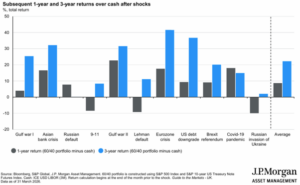
History, as they say, never repeats itself. Well, not exactly perhaps. But while today’s challenges might be different from those of the past, one lesson appears remarkably consistent: markets often begin recovering long before investors feel comfortable again.
Jeremy Siegel, author of ‘Stocks for the Long Run’ [3], reached a similar conclusion after studying centuries of market history. Wars, recessions, inflation shocks, political crises and financial panics have all felt unique and deeply concerning at the time. Yet despite these setbacks, markets have continued to reward patient investors over the long term.
That doesn’t mean risks should be ignored of course. But it does suggest that waiting for complete certainty can be an expensive strategy, which is why diversification, sensible asset allocation and risk management remain essential to our investment process.
Looking back at the events on the J.P. Morgan chart, it’s hard to imagine that investors living through those episodes felt optimistic, but history tells us they didn’t need to be. They simply needed a sensible plan and the discipline to stick to it.
Perhaps that’s what “time in the market” has always meant.
We are always here to help you with any questions or concerns you may have. If you would like to talk to one of our Chartered Financial Planners, please contact us on 01223 233331 or email info@mmwealth.co.uk.
Disclaimer
Opinions constitute our judgment as of this date and are subject to change without warning. The value of investments and the income from them can go down as well as up, and you may not recover the amount of your original investment. Past performance is not a reliable indicator of future performance.
The information in this article is not intended as an offer or solicitation to buy or sell securities or any other investment, nor does it constitute a personal recommendation.
The information contained within this blog is based on our understanding of legislation, whether proposed or in force, and market practice at the time of writing. Levels, bases and reliefs from taxation may be subject to change.
[1] Cambridge Associates – Managing Portfolios Through Equity Market Downturns
[2] J.P. Morgan Guide to the Markets – Guide to the Markets | J.P. Morgan Asset Management
[3] Stocks for the Long Run by Jeremy Siegel, first released in 1994.